Quantum's Useful Era Starts With Hybrid
Quantum computers will not replace supercomputers or AI. In life sciences, they are becoming a third engine that works alongside both.
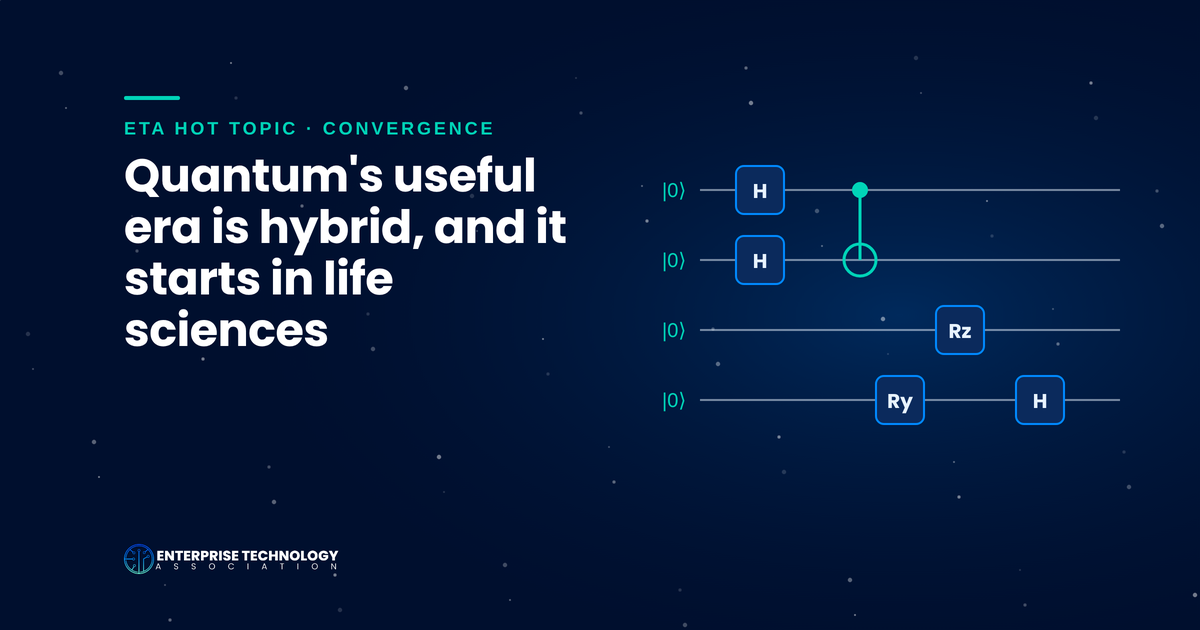
Early attempts to run whole drug discovery workflows on quantum hardware failed. Machines were too noisy and too small. By 2026 the industry has settled on a different model: hybrid stacks where GPUs run AI, CPUs and HPC handle classical chemistry, and quantum processors take the narrow slices of molecular simulation where they have an edge.
What changed this year
- Access widened. On November 6, 2026, IBM unveiled a Quantum System Two in Chicago, its most advanced system, to power a National Quantum Algorithm Center open to scientists and non-quantum companies. UChicago researchers reported in July that experiments on the system demonstrated quantum advantage.
- Biology results landed. Algorithmiq, Cleveland Clinic, and IBM won Wellcome Leap's Quantum for Bio challenge by simulating key steps of photodynamic cancer therapy on real quantum hardware.
- Error correction improved. Quantinuum reported a logical qubit nearly 100 times more reliable than its physical qubits, and is targeting fault-tolerant computing by 2029.
- Cloud bundles formed. Cloud providers now package quantum access with HPC and AI services for life sciences customers.
How to read the hype
The market for quantum in drug discovery is still small, estimated at $200 to $350 million in 2026. Most value today is learning: building algorithms, data pipelines, and teams that are ready when fault-tolerant hardware arrives.
A practical readiness checklist
- Identify one or two problems in your organization that are truly quantum-shaped: molecular simulation, optimization, or materials.
- Get hands-on through a cloud quantum service or a regional testbed before buying anything.
- Inventory encryption now. The same progress that helps chemistry threatens today's public key cryptography, so post-quantum migration belongs on the roadmap.
- Cross-train a small team across AI, quantum, and your domain. Translators will be the scarcest talent of the decade.
Get the next one in your inbox.
Events, program news and the monthly roundups from ETA.