Orbital Data Centers: The Next Frontier for AI Infrastructure
In one month, Google ran a model on a TPU in orbit, voters rejected data centers in 40 of 41 local measures, and SpaceX reportedly ordered racks for space. Here is what is real, what is hype, and what enterprise leaders should do now.
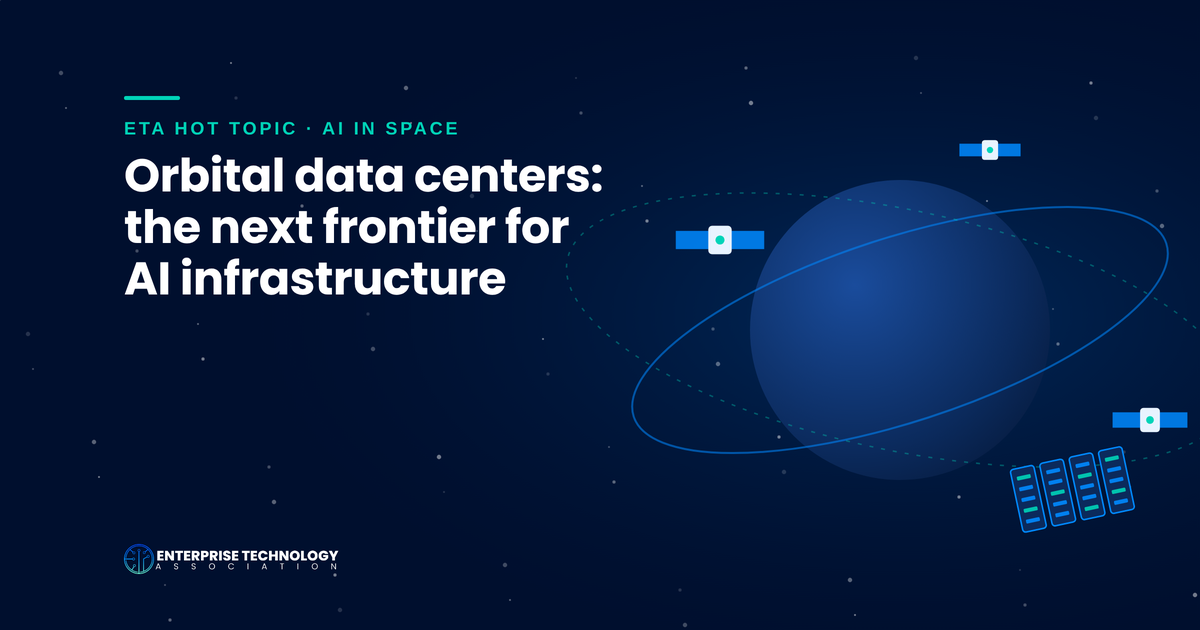
On October 30, 2026, a refrigerator-sized satellite passing over Svalbard, Norway downlinked a three-line haiku. It was written by Gemma running on four Trillium-generation TPUs aboard Google's first Project Suncatcher prototype, built with Planet and launched October 1 on SpaceX's Transporter-18 rideshare. Google called it the first AI response from a data center class TPU in orbit.
A poem is a modest payload. The signal behind it is not. AI infrastructure is running into limits on the ground, and some of the largest technology companies on Earth are now testing whether the answer is above it.
Why compute is looking up
The case for orbital data centers rests on three constraints that AI leaders already feel.
- Power. In a sun-synchronous orbit, solar panels see near-constant sunlight with no weather, no night, and no grid interconnection queue.
- Land and permitting. Data center projects are stalling. Data Center Watch counted 75 projects worth about $130 billion delayed or blocked in the first quarter of 2026 alone, and on November 3 voters sided against data centers in 40 of 41 local ballot measures.
- Data gravity in space. Satellites generate far more data than ground stations can receive. Processing it where it is collected beats shipping it home raw.
Who is actually flying hardware
The sector has moved from white papers to flight-proven demos. As of November 1, 2026, 21 of 53 tracked orbital data center programs had flown their own compute or storage hardware, according to New Space Economy.
- Kepler Communications: 40 NVIDIA Jetson Orin modules across 10 laser-linked satellites. The only commercial orbital compute service in operation, open to customers since April 2026.
- Axiom Space: two orbital data center nodes hosted on Kepler satellites, launched January 11, 2026 as a commercial offering.
- Google Project Suncatcher, with Planet: a prototype with four TPUs. First AI response on October 30; two linked satellites planned for 2027.
- Starcloud: flew an NVIDIA H100 on Starcloud-1 in November 2025, trained the first AI model in orbit that December, and filed with the FCC for up to 88,000 satellites.
- SpaceX and xAI: an FCC application for up to 1 million orbital compute satellites, with launches targeted for 2027. No approvals or confirmed customers yet.
- Sophia Space: an orbital data center operating system running on Kepler's cluster, the first software partner on a live orbital cluster.
The economics debate is the real story
The bull case is loud. SpaceX folded xAI into a $1.25 trillion company with orbital compute as its central rationale. A November 6 analyst note from FundaAI claims SpaceX ordered 6,000 space-rated racks for 2027, roughly 1 GW of compute. SpaceX has not confirmed it.
The skeptics are specific. Google's own data center energy chief has said space facilities could cost up to 100 times more than terrestrial ones, and Suncatcher's project lead does not expect orbital compute to beat ground compute on cost within five years. SpaceX's own pre-IPO filing calls orbital AI compute unproven and possibly not commercially viable.
Physics explains the gap. In vacuum there is no air to carry heat away, so every watt must be radiated. Shedding one megawatt at 20 degrees Celsius takes roughly 1,200 square meters of radiator, about four tennis courts. Add radiation hardening, launch cost, debris risk, and repair that requires a rocket, and the math is hard.
The regulatory map is empty, too. No jurisdiction has a binding regime for orbital data centers, and the FCC has not granted any of the mega-constellation filings.
What enterprise leaders should do now
Orbital compute is not a 2027 procurement line. It is a 3 to 5 year watch item with near-term implications.
- Separate the two markets. Orbital edge AI, processing satellite data in space, is commercial today. Orbital hyperscale, training frontier models off-planet, is a bet on Starship economics.
- Pressure-test your ground plan. If your AI roadmap assumes new local capacity, the November ballot results are the risk to model, not launch costs.
- Watch three signals. FCC action on constellation filings, published per-inference pricing from any orbital operator, and results from Google's 2027 laser-link test.
- Mind sovereignty. Data processed in orbit raises open questions about jurisdiction, export control, and compliance. Bring legal in early.
Join the conversation
ETA convenes the leaders building and buying AI infrastructure. Explore the AI in Space hub, subscribe to the ETA newsfeed, and meet the people shaping this market at AI Week, produced by Enterprise Technology Association, and the US AI Congress on March 24-25, 2027.
Get the next one in your inbox.
Events, program news and the monthly roundups from ETA.