
The cloud is leaving the ground.
AI is running in orbit today. Hyperscalers and startups are racing to put data centers in space, while communities on Earth push back on new ones. ETA tracks what is real, what is hype, and what it means for leaders adopting AI.
Updated November 8, 2026 · Stats checked weekly, stories added daily
Where things stand
Orbital edge AI
Small GPUs on satellites analyze imagery and signals where they are collected, then downlink only results.
Orbital hyperscale
Gigawatt clusters for training and serving frontier models, powered by constant sunlight. Depends on launch costs, radiator physics, and regulators.
Read the analysis
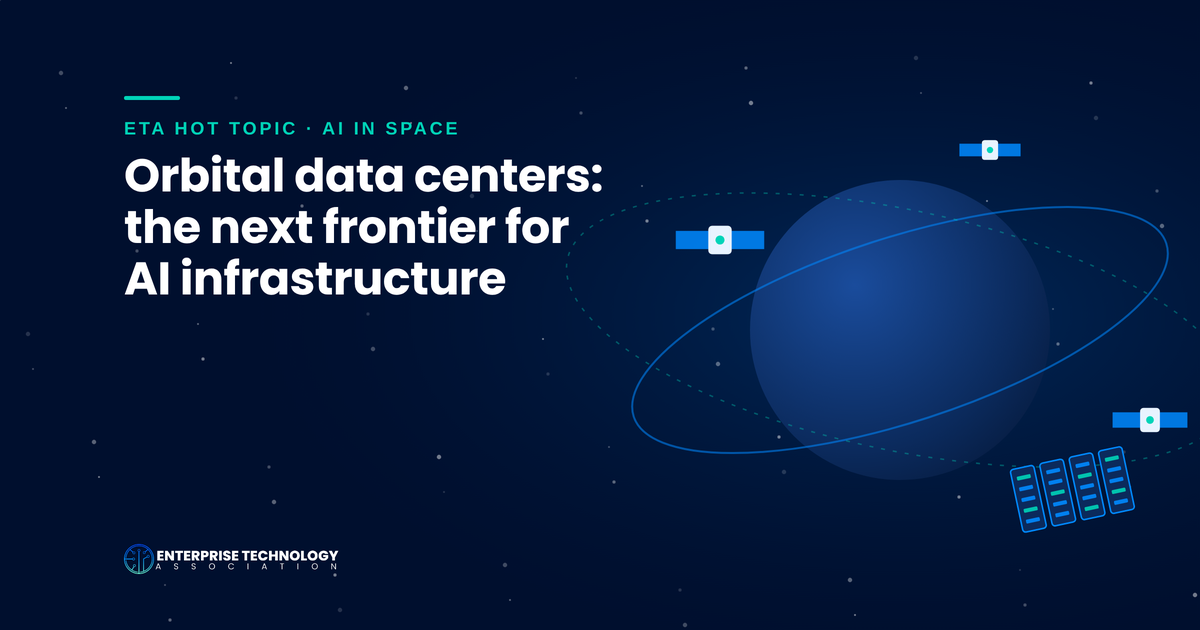 Feature · November 8, 2026Orbital Data Centers: The Next Frontier for AI InfrastructureIn one month, Google ran a model on a TPU in orbit, voters rejected data centers in 40 of 41 local measures, and SpaceX reportedly ordered racks for space. Here is what is real, what is hype, and what enterprise leaders should do now.Read the feature
Why the Smartest AI in Space Never Comes Home
The orbital AI market that is making money today is not about training giant models. It is about not sending data to Earth at all.
Grounded: Why Local Data Center Fights Are Pushing Compute Into Orbit
The 2026 midterms turned data centers into a ballot issue. The industry's most ambitious response is to leave the ground entirely.
Latest news
Curated by ETA, each story with our take on what it means for leaders adopting AI.
- MarketsMezhaNov 8, 2026
Google’s data center energy chief says space facilities could cost up to 100 times more (opens on Mezha)
ETA take: The loudest skeptic is inside a company flying TPUs in orbit. Treat orbital hyperscale as a long bet, not a procurement plan.
- MarketsFourWeekMBA, citing FundaAINov 7, 2026
Analyst note claims SpaceX ordered 6,000 space-rated racks for 2027 (opens on FourWeekMBA, citing FundaAI)
ETA take: Roughly 1 GW of compute if true. SpaceX has not confirmed it, so watch for supplier disclosures before planning around it.
- MarketsNew Space EconomyNov 4, 2026
21 of 53 tracked orbital data center programs have now flown hardware (opens on New Space Economy)
ETA take: The field has real flight heritage, but no jurisdiction has a dedicated legal regime for compute in orbit yet.
- Policy24/7 Wall St.Nov 4, 2026
Voters side against data centers in 40 of 41 local ballot measures (opens on 24/7 Wall St.)
ETA take: Community trust is now a gating factor for AI capacity. Siting, energy, and engagement plans belong in every AI readiness strategy.
- Orbital ComputeDatacenterDynamicsNov 2, 2026
Google's Project Suncatcher runs first workload on orbital TPU, but company admits space data centers cost 100x more than terrestrial (opens on DatacenterDynamics)
ETA take: A TPU has run a real workload in orbit, but Google's own admission of a 100x cost gap means space data centers are still research. Do not plan capacity around them yet.
- Orbital ComputeGoogleOct 30, 2026
Google’s Suncatcher prototype returns the first AI response from a data center class TPU in orbit (opens on Google)
ETA take: A narrow but real first. The 2027 test of two laser-linked satellites is the milestone that matters for clusters.
- LaunchesFree Press JournalOct 1, 2026
Suncatcher prototype with four TPUs launches on SpaceX Transporter-18 (opens on Free Press Journal)
ETA take: Built with Planet to test radiation and thermal limits. Hardware survival data will shape every orbital compute design.
- Orbital ComputeChannel InsiderAug 24, 2026
SpaceX targets late 2027 for its first orbital AI compute satellite, with larger deployments in 2028 (opens on Channel Insider)
ETA take: The timeline is now public. The FCC filing for up to 1 million satellites still has no approval and no named customers.
- Orbital ComputeTechraisalApr 14, 2026
Kepler opens the largest operational orbital compute cluster to commercial customers (opens on Techraisal)
ETA take: Forty edge GPUs across ten laser-linked satellites. This is the orbital edge market, and it is open for business.
- PolicySpaceNewsFeb 4, 2026
Starcloud asks the FCC to approve up to 88,000 orbital data center satellites (opens on SpaceNews)
ETA take: Spectrum and debris rules, not just engineering, will decide who scales first.
- LaunchesSoftwareSeniJan 11, 2026
Axiom Space launches two orbital data center nodes as a commercial service (opens on SoftwareSeni)
ETA take: Hosted on Kepler satellites. Shared orbital infrastructure is emerging the way colocation did on the ground.
Common questions
What is an orbital data center?
A satellite or cluster of satellites carrying computing and storage hardware, powered by solar energy and linked to Earth and to each other by radio or laser.
Are orbital data centers operating today?
Yes, at small scale. Kepler Communications runs a commercial orbital compute service, and Google, Starcloud, and others have run AI models in orbit. Large-scale clusters remain proposals.
Will space data centers be cheaper than ground data centers?
Not soon, by most expert estimates. Google’s Suncatcher lead does not expect orbital compute to beat ground costs within five years.
What should my organization do now?
Treat orbital hyperscale as a watch item, explore orbital edge AI if you use satellite data, and stress-test any AI plan that depends on new local data center capacity.
Keep exploring
 AI Agents at WorkAI agents are clocking in. Is your team ready?40% Respondents at organizations above $1B revenue that report scaling AI agents in 2026, up from 27% a year earlier (McKinsey)Explore the hub
 AI Power and the GridElectricity is now the limit on AI growth17% Growth in global data center electricity use in 2025, vs 3% for all electricity demand (IEA)Explore the hub
 Physical AI and Humanoid RobotsPhysical AI leaves the lab for the factory floor5M Industrial robots operating in factories worldwide in 2025, a record, after installations rose 11% (IFR)Explore the hub
 AI, Quantum, and Biotech ConvergenceAI, quantum, and biotech are becoming one stack.173+ AI-designed drug programs in clinical development in early 2026Explore the hub
Take this conversation in person
Meet the leaders putting emerging tech to work at AI Week, produced by Enterprise Technology Association, and the US AI Congress.
Get hot topics by email.
New ETA analysis and the stories that matter, in the ETA member digest.